
Know your risks
while it is still
something you can act on.
Most genetic testing happens after a diagnosis, when the information can only explain what already happened. Proactive screening looks earlier — at inherited cardiovascular and cancer risk variants — so you and your physician can decide whether earlier or more frequent screening makes sense for you.

The cost of not testing
Population figures come from published hereditary-risk literature and are educational, not a prediction of your own result.
If your doctor or genetic counselor suggested this test, you are in the right place. Order below and we will make sure the results reach whoever is guiding your care.
Order a test
Choose the proactive health panel that fits your goals. Kits ship to your door, or drop your sample off at our Germantown lab. No appointment and no insurance claim required.
- ✓Run in PMC's own CLIA-certified lab in Germantown, MD
- ✓Clinically curated gene panels, reviewed by a licensed provider
- ✓Results in your secure portal with a plain-language summary
Is proactive testing right for you?
If any of these sound familiar, this test was built for your situation.
- Cancer, heart disease or stroke runs in your family.
- A relative was diagnosed young, or more than one relative was affected.
- You do not know much about your family medical history.
- You are planning a family and want to know what you carry.
- You want screening timed to your actual risk, not just your age.
- Your doctor or a genetic counselor suggested testing.
Answering yes to even one of these is a good reason to test now rather than after a diagnosis.
Family history is a clue. It is not an answer.
Plenty of people carry a risk variant with no family history they know of — records are incomplete, relatives are out of touch, and some conditions skip visible generations. Testing replaces a half-remembered family tree with something specific.
For some inherited risks, guidelines support starting screening earlier or repeating it more often. That decision is your physician’s, informed by a documented result.
Inherited variants are shared. A result gives siblings, children and parents a concrete reason to ask their own doctors about testing.
The value of a proactive result comes from having it before symptoms, while prevention and surveillance are still on the table.

Start where your family history points
Both risk panels are collected the same way and run in our own CLIA-certified laboratory. If you are not sure which fits, start with the conversation — we would rather you test for a reason.
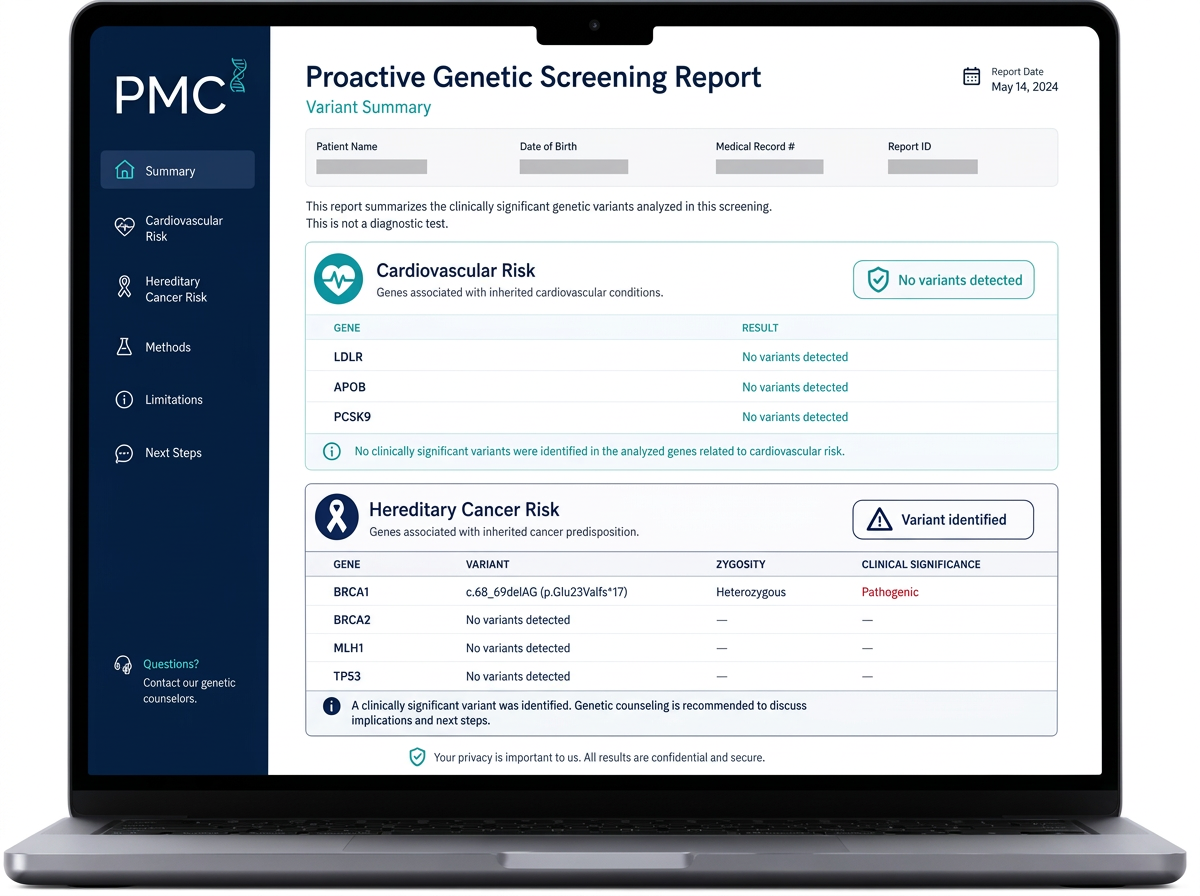
Clear about what was found — and what it does not mean.
A genetic result is a probability, not a verdict. Our reports are written to make that distinction plainly, and to give your physician the classification detail they need.
Genetic counseling: available with every panel. For hereditary cancer and cardiovascular results in particular, we recommend reviewing findings with a genetic counselor or your physician.
Who this is for
Proactive testing suits people who want a baseline while they are well — not people looking for reassurance about a symptom they have today.
A parent, sibling or grandparent diagnosed young is the most common reason people test.
Adoption, estrangement or simply incomplete records leave a real blank. Testing fills it.
Some inherited risks are worth understanding before pregnancy, alongside your obstetric care.
Old enough for prevention to matter, early enough for it to work.
Collected at home, run in our own lab
Tested once — your genome does not change, so the report stays valid for life.
Choose a panel and check out. A licensed physician in our network reviews and places the order at no extra cost.
A cheek swab in unmarked packaging, with instructions. No blood draw, no fasting, no appointment.
Prepaid FedEx overnight label, or drop it at our Germantown lab in person, Mon–Fri 9am–5pm.
Your report lands in a secure portal, then goes to your physician or a genetic counselor.
Questions people actually ask
If I test positive, does that mean I will get the disease?+
No. Most results describe increased risk, not certainty. Many people carrying a risk variant never develop the associated condition, and many without one still do. What a result changes is the screening and prevention conversation with your physician.
Can insurers use this against me?+
The federal Genetic Information Nondiscrimination Act (GINA) restricts health insurers and employers from using genetic information in coverage and employment decisions. It does not cover life, disability or long-term care insurance. If those are a concern for you, weigh that before testing.
Do I need genetic counseling?+
We recommend it for hereditary cancer and cardiovascular findings, and for the expanded panel in particular.
What does this mean for my family?+
Inherited variants are shared with blood relatives. A result of yours may be relevant to siblings, children and parents — the report is written so you can share it with them and their providers.
Is my genetic data sold or shared?+
No. Results live in a HIPAA-compliant portal only you can open, and we do not sell or license your genetic data.
How long do results take?+
Typically a couple of weeks from the day your sample reaches the lab — longer than an infection panel, because variant interpretation is careful work.
Should I test if I have no symptoms and no family history?+
That is exactly the proactive case: a baseline while you are well. If you have symptoms now, see a physician instead — this is not a diagnostic test.
Monthly membership
A different test mailed to you every month
One kit arrives each month in unmarked packaging, prepaid both ways. Members rotate through the full PMC panel menu, so you stay ahead of the things that usually go unchecked between annual visits.
Testing is not a diagnosis; results are reviewed with a licensed provider.
- ✓One kit shipped every month, prepaid both ways
- ✓Rotate through every PMC panel
- ✓Results in your secure portal in 24-48 hours
- ✓Provider review included with every result
- ✓Skip a month or swap your panel anytime
- Mo 1Comprehensive Genetic Health Screening Panel
- Mo 2Genetic Risk for Cancer
- Mo 3Genetic Risk Assessment for Heart Health