
Stop guessing which medication
helps your mood
Your genes affect how quickly you break down antidepressants, antipsychotics and mood stabilizers — part of why one person does well on a standard dose and the next has side effects or no response at all. A pharmacogenomic (PGx) test reads those genes once, from a cheek swab, and gives your prescriber information they can weigh alongside everything else they know about you.

The cost of not testing
Figures reflect published literature on antidepressant response and are provided for education, not as a prediction of your result.
If your counselor or therapist suggested this test, you are in the right place. Order below and we will make sure the results reach the people caring for you — your prescriber, and your counselor if you want them in the loop.
Order a test
Choose the mental health PGx panel that fits your care. Kits ship to your door, or drop your sample off at our Germantown lab. No appointment and no insurance claim required.
- ✓Run in PMC's own CLIA-certified lab in Germantown, MD
- ✓Gene-drug results your prescriber can act on
- ✓Results in your secure portal with a plain-language summary
Is this test right for you?
If any of these sound familiar, this test was built for your situation.
- A medication for depression or anxiety has not worked for you before.
- Your current medication helps a little, but not enough.
- Side effects made you stop a medication or lower the dose.
- You have switched medications more than once in the last year.
- You are about to start a new psychiatric medication.
- Your counselor or prescriber suggested genetic testing.
Answering yes to even one of these is a good reason to test before the next prescription change.
Waiting 6-8 weeks to find out isn't best for you
That is the part nobody warns you about. Most psychiatric medications need weeks at a therapeutic dose before anyone can judge the result — so every attempt that does not fit costs a season of your life.
If you metabolize a drug slowly, a standard dose can behave like a high one. That can look like intolerance when it may be a dosing question.
If you clear a drug quickly, the level in your blood may stay too low to help, no matter how patiently you wait.
Many drugs compete for the same metabolic enzymes. When you are taking more than one, that interaction is worth knowing about in advance.

The genes that control how you
process medication
Our Neurological Disorders PGx panel looks at the drug-metabolizing enzyme genes with the best-established prescribing guidance, then reports your predicted metabolizer status for each.
The enzymes that break down most antidepressants and antipsychotics. Your status is reported as poor, intermediate, normal, rapid or ultrarapid.
Grouped by class, so the report stays useful if your prescriber changes direction later.
Where recognized bodies such as CPIC have issued gene-drug guidance, the report reflects it rather than our own opinion.
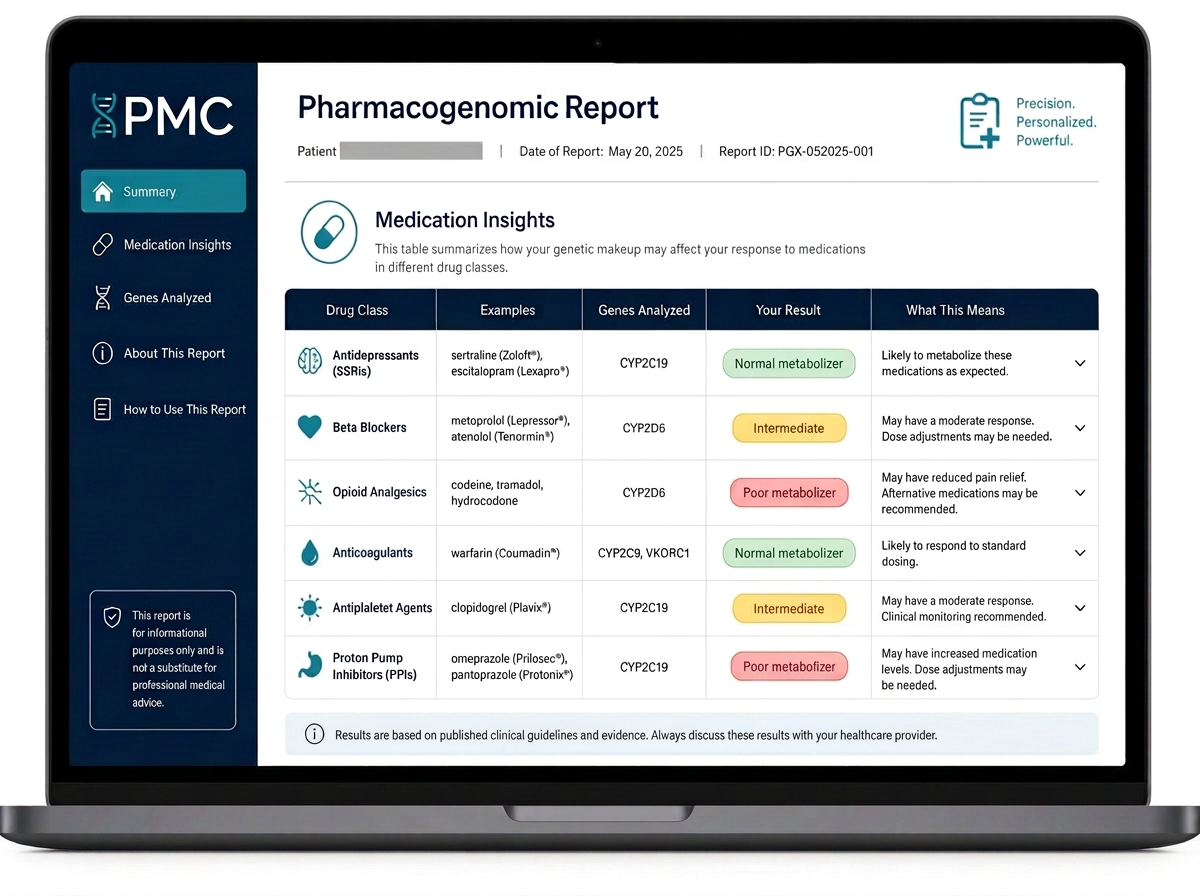
Written to be handed to your prescriber.
Two audiences, one document: a plain-language summary for you, and the gene-by-gene clinical detail your psychiatrist, PCP or nurse practitioner needs.
Antidepressants, antipsychotics, mood stabilizers and other medications your prescriber may consider.
Your DNA does not change, so the same report stays useful if your care plan changes.
Download it or have us send it to your provider, counselor, or anyone you choose.
Who this is for
Pharmacogenomic testing is most useful at a decision point — before a new prescription, or after one has not worked.
Repeated non-response is the most common reason people test. It may reflect how you metabolize these drugs.
If standard doses consistently feel like too much, metabolizer status is worth knowing.
Testing before the first prescription puts the information in hand for the first decision, not the fourth.
Overlapping metabolic pathways are easier to plan around when your enzyme status is documented.
One swab. One time. Yours to keep.
No blood draw, no clinic visit, no repeat testing — your genome does not change.
Check out in about two minutes. A licensed physician in our network reviews and places the order at no extra cost.
The kit arrives in unmarked packaging. Collection takes under a minute and needs no fasting or prep.
Use the prepaid FedEx overnight label, or drop it at our Germantown lab in person, Mon–Fri 9am–5pm.
Your report lands in a secure portal. Download it, or have us send it to your provider.
Counseling centers, crisis lines and psychiatry practices
If you refer clients for pharmacogenomic testing, PMC can run it under your own brand — university counseling centers, 988 and crisis call centers, social work practices and concierge physicians.
Keep your counselor and your prescriber on the same page
Therapy and medication work best when the people handling each one are looking at the same information. Your report is built to be shared — with whoever you choose, and no one else.
Your counselor cannot prescribe, but they see the week-to-week reality. The plain-language summary gives you both something concrete to bring into the conversation about how a medication is landing.
Download the clinical section from your portal, or tell us where to send it and we will deliver it directly to your psychiatrist, PCP or nurse practitioner.
Nothing is shared without your say-so. No insurance claim is filed, so no explanation of benefits goes out to a policyholder.
What people say
after testing
Shared with permission. Individual experiences vary, and a PGx result never guarantees an outcome.
“After four years of trying different medications, my psychiatrist finally had a starting point instead of a guess.”
“My therapist mentioned it first. Swabbing at home took a minute and I had the report before my next appointment.”
“Turns out I clear one of the medications I had been on very quickly. That explained a lot about the last two years.”
FAQs and insights
My counselor recommended this — what do I do next?+
Order the panel below — you do not need a referral code or paperwork from their office. Swab at home, mail the kit back, and share the report with your counselor and your prescriber when it lands in your portal.
Can my therapist see the results too?+
Only if you want them to. You can download and share the report yourself, or tell us who to send it to. Nothing goes out without your permission.
How long do results take?+
Most reports are ready within a few business days of your sample arriving at our Germantown lab. You get an email the moment it posts to your secure portal.
Will this tell me which antidepressant to take?+
No, and be skeptical of any test that claims to. It reports how your body is likely to process specific medications. Choosing a medication involves your diagnosis, history, other prescriptions and preferences — that is your prescriber’s call, informed by this.
Does my psychiatrist have to order it?+
No. A licensed physician in our network reviews and places the order during checkout. That said, tell your prescriber you are testing — the report is only useful once it reaches them.
Do I need to stop my current medication?+
No. Never stop or change a psychiatric medication on your own, and nothing about this test requires it. PGx reads your DNA, which is unaffected by what you are currently taking.
How much does it cost?+
The Neurological & Psychiatric PGx panel starts at $249. You pay PMC directly — no insurance claim is filed, so no explanation of benefits is mailed to your policyholder.
How long do results take?+
Typically a few business days from the day your swab reaches the lab. You will be notified when the report is ready.
Is my genetic data sold or shared?+
No. Results live in a HIPAA-compliant portal only you can open, and we do not sell or license your genetic data.
Do I ever need to repeat it?+
No. Your DNA does not change, so the same report stays valid if you switch prescribers or revisit medication years later.
Monthly membership
A different test mailed to you every month
One kit arrives each month in unmarked packaging, prepaid both ways. Members rotate through the full PMC panel menu, so you stay ahead of the things that usually go unchecked between annual visits.
Testing is not a diagnosis; results are reviewed with a licensed provider.
- ✓One kit shipped every month, prepaid both ways
- ✓Rotate through every PMC panel
- ✓Results in your secure portal in 24-48 hours
- ✓Provider review included with every result
- ✓Skip a month or swap your panel anytime
- Mo 1Neurological & Psychiatric
- Mo 2Pain Management
- Mo 3Comprehensive Pharmacogenetics Certificate