If pain medications
don’t work,
there may be a reason.
Codeine and tramadol do not work as they arrive — your body has to convert them, using an enzyme called CYP2D6. Some people carry a version that converts poorly, which can mean little relief at a normal dose. Others convert unusually fast, which raises a safety question instead. Our 25-gene panel documents where you fall, from one cheek swab.

The cost of not testing
Population figures come from published pharmacogenomic literature and are educational, not a prediction of your own result.
If your doctor, surgeon or pain specialist suggested this test, you are in the right place. Order below and we will get the report to your prescribing team before your next visit.
Order a test
Choose the pain management PGx panel that fits your care. Kits ship to your door, or drop your sample off at our Germantown lab. No appointment and no insurance claim required.
- ✓Run in PMC's own CLIA-certified lab in Germantown, MD
- ✓Gene-drug results your prescriber can act on
- ✓Results in your secure portal with a plain-language summary
Is this test right for you?
If any of these sound familiar, this test was built for your situation.
- A pain medication did little or nothing for you.
- A standard dose left you groggy, nauseated or foggy.
- You have surgery or a procedure coming up.
- You are managing ongoing pain with more than one medication.
- You want a non-opioid plan chosen with evidence behind it.
- Your surgeon, dentist or pain specialist suggested testing.
Answering yes to even one of these is a good reason to test before your next prescription or procedure.
“It didn’t do anything” is a clinical finding.
People who do not respond to standard pain medication are too often assumed to be exaggerating or drug-seeking. Metabolizer status is one documented, testable explanation — and it belongs in your chart.
Codeine and tramadol are prodrugs. If CYP2D6 converts them poorly, blood levels of the active form may stay low no matter the dose.
Ultrarapid conversion produces the active drug quickly, which is a recognized safety concern rather than a benefit.
CYP2C9 affects how some non-opioid pain relievers are cleared, which is relevant if standard doses have caused problems.

25 genes across the medications pain care actually uses
One swab covers opioid and non-opioid analgesics together, because most pain plans use both — and because the non-opioid half is where a lot of avoidable trouble lives.
Conversion and clearance for codeine, tramadol, oxycodone, hydrocodone and methadone, plus receptor-level variants.
Relevant to celecoxib, ibuprofen and other NSAIDs — the medications most people are told to try first.
Includes agents used around surgery and common adjuncts such as certain antidepressants used for nerve pain.
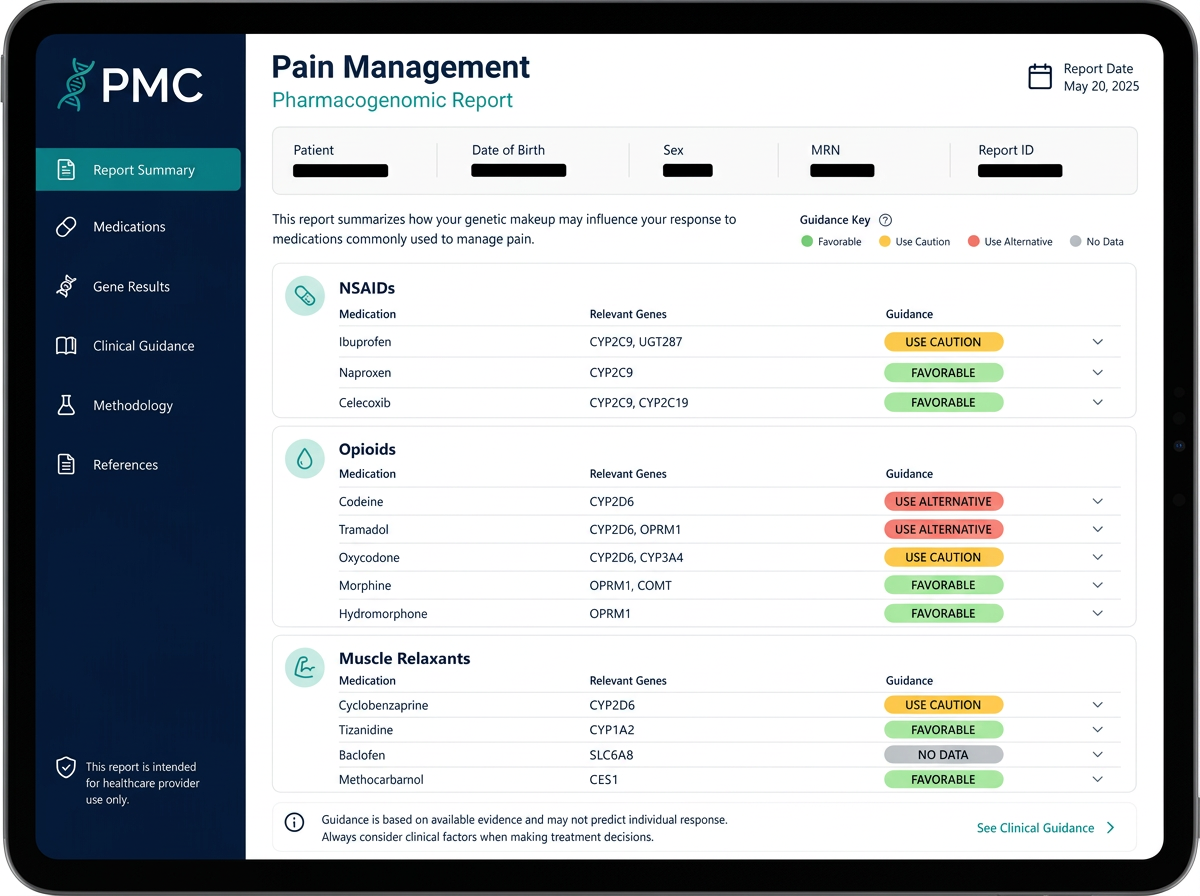
Documentation you can put in front of anyone.
Useful with your pain specialist, your surgeon’s pre-op team, and any new provider who does not yet know your history.
Who this is for
The information matters most before a prescription is written — and before surgery, when there is still time to plan.
Especially if more than one medication has been tried without much effect.
Pre-op is a natural moment to test: anesthesia and post-op analgesia are both on the panel.
Unusual sedation, nausea or non-response after a prior procedure is worth explaining rather than repeating.
Overlapping pathways are easier for a prescriber to plan around when your enzyme status is documented.
One swab. One time. Yours to keep.
No blood draw and no clinic visit — and never a repeat test, because your genome does not change.
Check out in about two minutes. A licensed physician in our network reviews and places the order at no extra cost.
Unmarked packaging, instructions inside. Collection takes under a minute with no fasting or prep.
Prepaid FedEx overnight label, or drop it at our Germantown lab in person, Mon–Fri 9am–5pm.
Your report lands in a secure portal, ready to download or forward.
Questions people actually ask
Is this a drug test?+
No. It does not detect medication in your body and it is not used for monitoring or compliance. It reads genes that affect how you metabolize certain drugs.
Will this get me a prescription?+
No. PMC does not prescribe. The report gives your provider metabolic information; every prescribing decision stays with them.
I have surgery scheduled — when should I test?+
As early as you can, so the report is in your chart before pre-op planning. Most reports are ready within a few business days of your swab reaching our Germantown lab.
Does my doctor need to order it?+
No — a licensed physician in our network places the order during checkout. Do tell your own provider, since the report is only useful once they have it.
How much does it cost?+
The Pain Management PGx panel starts at $249. You pay PMC directly, so no insurance claim is filed and no explanation of benefits is mailed.
Is my genetic data sold or shared?+
No. Results live in a HIPAA-compliant portal only you can open, and we do not sell or license your genetic data. You choose who else receives a copy.
Do I need to repeat it later?+
No. The same report stays valid for future prescriptions, new providers and future surgeries.
Monthly membership
A different test mailed to you every month
One kit arrives each month in unmarked packaging, prepaid both ways. Members rotate through the full PMC panel menu, so you stay ahead of the things that usually go unchecked between annual visits.
Testing is not a diagnosis; results are reviewed with a licensed provider.
- ✓One kit shipped every month, prepaid both ways
- ✓Rotate through every PMC panel
- ✓Results in your secure portal in 24-48 hours
- ✓Provider review included with every result
- ✓Skip a month or swap your panel anytime
- Mo 1Pain Management
- Mo 2Neurological & Psychiatric
- Mo 3Anesthesiology